Nearly a decade after its tentative debut, ray tracing has evolved from a niche marketing gimmick into the visual bedrock of modern gaming. What began as a hardware sales pitch is now a quiet revolution—a digital sun that casts authentic shadows, turning every reflective puddle into a mirror held up to virtual worlds. In 2026, the technology is no longer just about crisp reflections; it has become the silent stagehand of atmosphere, meticulously arranging light and shadow like a master glassmaker shaping molten silica into flawless lenses. Games today don’t simply look better—they feel more real, as if a painter’s brush were guided by the laws of physics itself, never missing a stroke.
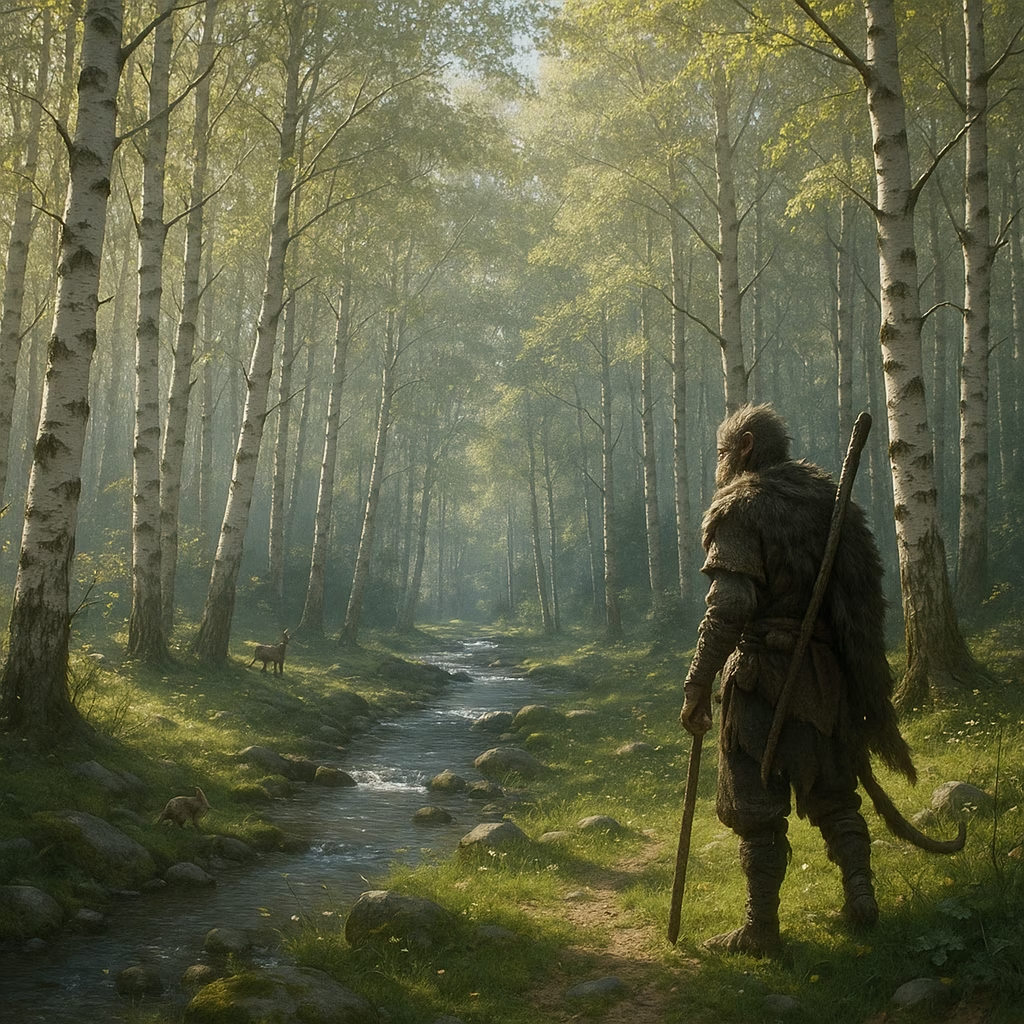
Ray tracing, at its core, simulates the physical behavior of light. Instead of relying on pre-baked lightmaps or screen-space shortcuts, it calculates how photons bounce between surfaces, blending colors and casting shadows with a fidelity that older techniques could only approximate. Path tracing—a more exhaustive variant—pushes this even further by tracing entire light paths through a scene. The result? A red neon sign no longer just glows; it bleeds its hue onto nearby metal, and a flashlight in a horror title doesn’t only illuminate—it sculpts fear out of darkness. This shift has been as transformative as the leap from 2D sprites to 3D polygons, yet its subtlety often goes unnoticed until you toggle the setting off and realise how flat the world becomes.
The lineup of ray-traced titles in 2026 demonstrates that the technology is now a canvas, not a crutch. Capcom’s Resident Evil Requiem (February 2026) uses global illumination and path tracing on PC and PS5 Pro to transform the Rhodes Hill Chronic Car Center’s catacombs into a masterclass in terror. Light becomes a resource so scarce that when a torch flame wavers, shadows stretch like fingers across damp stone. Similarly, the studio’s upcoming Pragmata (April 2026) transplants the RE Engine’s capabilities to a lunar base, where polished corridors reflect the chaotic disassembly of robots into a ballet of sparks and particles. The effect is akin to watching a futuristic opera staged inside a hall of mirrors.
Open-world epics are also reaping the rewards. Crimson Desert (March 2026) from Pearl Abyss marries global illumination with ray-traced reflections across vast medieval landscapes. A storm rolling in doesn’t just dim the sky—it reconfigures the entire emotional palette, while torchlight wraps around stone towers like liquid amber. Remarkably, these features survive on consoles, proving that in-house engines can now punch well above their weight. Meanwhile, CD Projekt Red’s Cyberpunk 2077 remains a benchmark, its Overdrive path-tracing mode turning Night City into a digital jewel box. The neon-soaked streets are so tangibly alive that you can almost feel the hum of flickering signs on your retina.
Not all ray-traced experiences demand the latest hardware. Doom: The Dark Ages (2025) and Indiana Jones and the Great Circle (2024) both mandate ray tracing, yet deliver high frame rates thanks to the idTech engine’s meticulous optimization. The Vatican’s hallowed halls glow with a solemn reverence, while the demon-slaying action of Doom never sacrifices responsiveness for visual opulence. It’s a balancing act that would have seemed impossible in the early days, when even a single reflection could bring a high-end GPU to its knees.
Remedy Entertainment continues to champion atmospheric lighting. Alan Wake II’s path tracing mode bathes the Pacific Northwest forests in a spectral ambience where every dripping leaf and mossy rock seems to breathe. The flashlight isn’t just a tool; it’s a weapon that sculpts safety from the oppressive night. In the same vein, the studio’s earlier gem Control remains a must-play testament to how ray-traced transparency and reflections can turn an office complex into a brutalist cathedral, where flying debris is mirrored across polished floors as if the Oldest House itself were gazing back at you.
Elsewhere, the technology flirts with the unreal. Minecraft’s path tracing implementation, however blocky the source material, turns its cubic landscape into a miniature diorama bathed in warm caustics. It’s less a game and more a museum exhibit—a showcase of what’s possible when infinite rays meet infinite creativity. Portal RTX goes further, making the titular portals into perfectly reflective membranes that double the visual wonder of every puzzle chamber.
Looking ahead, 2026 is poised to deliver even more mandatory ray tracing as engines mature and hardware costs drop. Upcoming titles like The Witcher 4 on Unreal Engine 5 promise a generational leap, while Rockstar’s Grand Theft Auto VI is expected to weave ray-traced global illumination through its sprawling metropolis. The line between pre-rendered cinematics and real-time gameplay continues to blur. For players, it means that sunlight will no longer just illuminate a meadow—it will tell a story. And for the industry, ray tracing has become the silent metronome of progress, ticking away imperceptibly, yet fundamentally reshaping every frame.