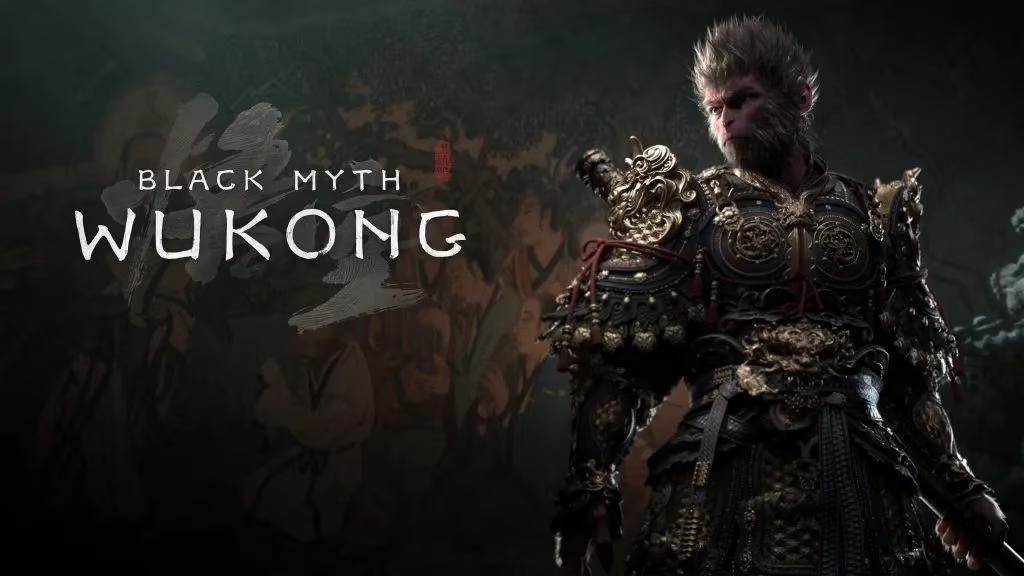
In the summer of 2024, the gaming world witnessed a phenomenon that still resonates powerfully today. Game Science’s debut action RPG, Black Myth: Wukong, didn’t just launch—it detonated. Within a week, it had sold an astonishing 10 million copies. But that was merely the opening act. Two weeks after release, Daniel Wu of Hero Games, the studio’s largest external shareholder, confirmed to Bloomberg that the title had moved 18 million units. Even in 2026, that two-week sprint is still talked about as one of the most explosive openings in video game history.
How does a new IP from a relatively unknown developer achieve such staggering numbers? Was it just the pent-up anticipation since its first jaw-dropping trailers? Or is there a deeper story here? The truth lies in a flawless combination of craft, timing, and cross-cultural resonance. Game Science poured over six years of passion into the project with a budget of $70 million—a lean figure by modern AAA standards. Yet the final product radiated blockbuster quality in every frame. The combat felt tight and responsive, the boss fights were spectacular set pieces, and the art direction painted a surreal, mythological China that captivated both Eastern and Western audiences. Our own review gave the game a perfect 10 out of 10, specifically highlighting its combat, art direction, graphics, and those unforgettable boss encounters.
But the shockwaves went far beyond critical acclaim. The sales velocity immediately set it apart from all but a handful of prestige titles. To put it in perspective, 18 million copies in under a fortnight placed Black Myth: Wukong on a trajectory that rivaled or outpaced heavyweights like The Legend of Zelda: Tears of the Kingdom and Elden Ring in their launch windows. Can it be attributed solely to China’s huge player base? That certainly played a role, but the global split on platforms like Steam told a different story—Western markets devoured the game just as eagerly. The meticulous English localization and the universal appeal of Journey to the West’s themes of struggle, transformation, and defiance erased any regional barriers.
Daniel Wu’s projection from that time still echoes: he believed the game could reach lifetime sales of 30 million. Given the momentum, many industry observers already saw that target as modest. Fast forward to 2026, and while official figures for the last two years remain closely guarded, insider estimates and market trends strongly suggest that Black Myth: Wukong has comfortably surpassed that milestone. It has become a permanent fixture in sales charts, buoyed by regular patches, quality-of-life improvements, and the inevitable post-launch content that kept its dedicated community thriving.
What about the long-rumored Xbox version? Back in 2024, PlayStation and PC owners monopolized the experience, leaving Xbox players staring enviously at the sidelines. Speculation ran rampant—some claimed a timed exclusivity deal with Sony, others cited technical challenges with the Xbox Series S’s hardware. Game Science offered no definitive timeline, only confirming that an Xbox Series X/S version was in development. Eventually, the studio did deliver, and by early 2025 the game finally landed on Microsoft’s console, bringing with it a wave of late adopters eager to begin their journey. The delay, while frustrating for fans, only prolonged the title’s presence in news cycles and arguably expanded its longer-term sales.
Looking at Black Myth: Wukong’s legacy from 2026, one can’t help but see it as a true industry disruptor. It proved beyond doubt that a game deeply rooted in non-Western mythology can dominate the global mainstream without compromising its soul. It also dismantled the notion that you need a $200 million budget and a decade of development to compete with the biggest franchises. Game Science’s 70 million investment—lean and focused—yielded a visual and mechanical masterpiece that continues to inspire indie and AAA teams alike.
And where does this leave the future? Naturally, conversations among fans never stray far from sequels, expansions, or perhaps an entirely new tale from the same universe. Game Science has remained characteristically tight-lipped, but the brand they’ve built virtually guarantees that Black Myth: Wukong won’t remain a solitary star. It has already reshaped expectations, proving that authenticity and artistry can triumph over conventional formula. If you haven’t yet stepped into the fur of the Destined One, ask yourself: what legend are you still waiting for? The Monkey King’s saga continues to echo, and its ripples will be felt for years to come.
Data referenced from NPD Group helps contextualize how Black Myth: Wukong’s rapid 18-million-in-two-weeks surge fits into broader market behavior: breakout launches typically convert best when strong day-one word of mouth aligns with wide storefront visibility, and sustained performance often depends on post-launch cadence (patches, optimization, and content beats) that keeps the title charting beyond the initial spike.