I will be honest—when Black Myth: Wukong first crashed onto my radar back in 2020, I genuinely thought someone had cooked up a fake demo. Game Science's action RPG blew the doors off expectations and instantly became the talk of the gaming world. Now that we are firmly in 2026, looking back at those early leaks still feels wild, especially the moment we learned the project had made the jump to Unreal Engine 5.
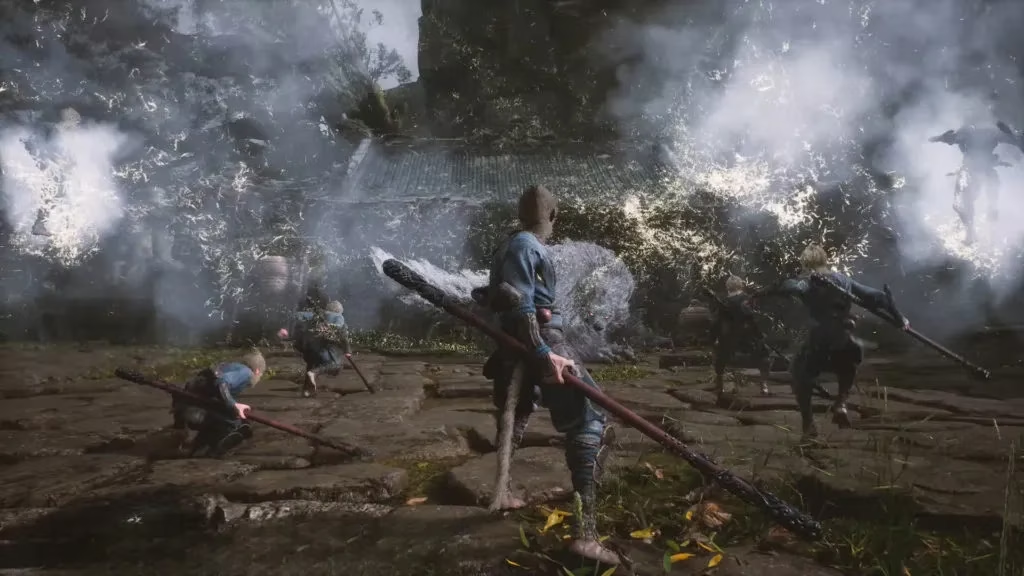
The whole story started because IGN jumped the gun a little. A tweet went up before it was supposed to, and even though it got yanked almost immediately, the internet never forgets. Wccftech managed to grab a screencap, and bam—the cat was out of the bag. The big headline? Game Science had switched engines. Black Myth: Wukong was no longer running on the tech from its debut showing; it was now being built on Unreal Engine 5.
That detail alone was enough to make my jaw drop. The game already looked like a million bucks in its first reveal, so hearing it was moving to UE5 felt like the cherry on top. Unreal Engine 5 promised insane geometry through Nanite and more natural lighting with Lumen, and for a project rooted in Chinese mythology with sweeping landscapes and fast, brutal combat, that kind of tech was a match made in heaven.
But the leaks did not stop there. According to the early info, the game was targeting 4K resolution at 60 frames per second, with ray tracing support thrown in for good measure. For an action RPG with this level of visual fidelity, that was a seriously ambitious goal. It was the kind of spec that made PC players start eyeing upgrades and console players cross their fingers.

At the time, Game Science had not officially confirmed any of these details, and the game still had no launch date or announced platforms. That uncertainty kept the rumor mill churning for months. I remember refreshing forums and social media daily, hoping for a new crumb of information. The February showing earlier that year had already given us another brief look, but the UE5 rumor made the wait feel even more agonizing.
Looking back from 2026, it is safe to say the hype was not misplaced. The game eventually launched in August 2024 and became a global phenomenon, proving that the switch to Unreal Engine 5 was a masterstroke. Those early 4K 60 FPS and ray tracing targets helped set expectations sky-high, and the final product delivered for many players.
Here is a quick breakdown of why that leak mattered so much:
| Leaked Detail | Why It Was a Big Deal |
|---|---|
| Engine switch to UE5 | Signaled next-gen visual ambitions and future-proofing |
| 4K at 60 FPS target | Showed a focus on smooth, high-fidelity performance |
| Ray tracing support | Promised more realistic lighting and reflections |
| Early IGN slip | Gave the community a rare unfiltered peek behind the curtain |
It was a full-blown hype train, and everyone wanted a ticket. 🚂🔥
Honestly, that is one of the things I love about this industry. A single pulled tweet or a stray screencap can spark weeks of discussion. The Black Myth: Wukong leak was a perfect example of how a little slip can turn an already exciting project into a full-blown hype train.
These days, the game is a known quantity, but I still get a kick out of revisiting the moment everything changed. Whether you were there from the 2020 debut or jumped in later, there is no denying that the Unreal Engine 5 switch was one of the earliest signs that Game Science was swinging for the fences. And in 2026, that ambition still stands tall.